
Aspire Veterinary Center

Urgent Care Sudden Limping
La Palma, CA · Bridge Spoke

Sudden Limping in Dogs
& Cats: Injury vs.
Neurological Emergency

Not all limping is equal. A “three-legged” dog may have a CCL tear; a dog “knuckling” their paws has a spinal emergency. Knowing the difference determines whether you have hours—or minutes—to act.
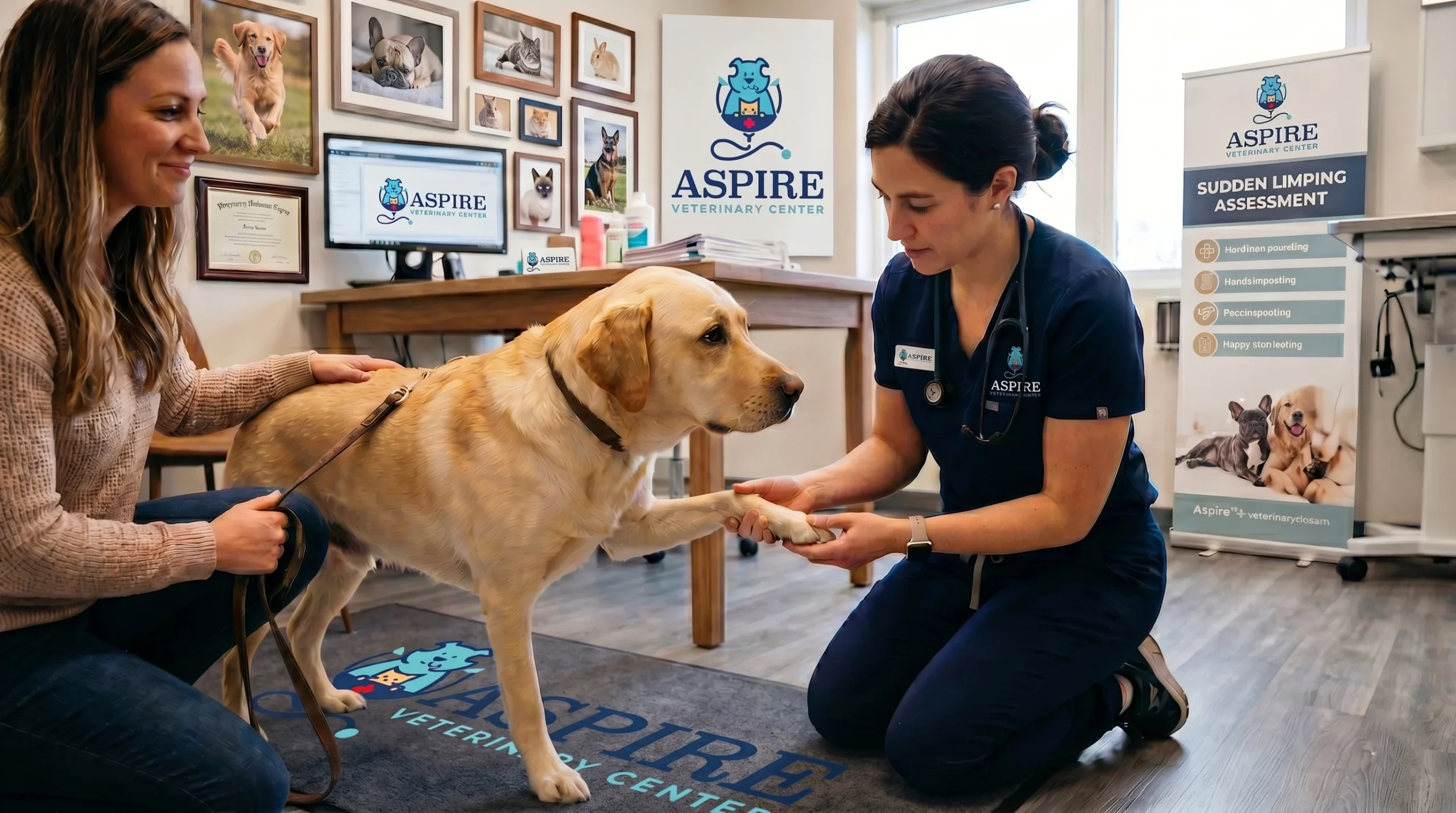
Veterinarian assessing a limping dog at Aspire Veterinary Center in La Palma CA

The 60-Second Answer

Sudden limping is usually orthopedic (bones/joints) or neurological (nerves/spine). If your pet is “three-legged” but alert, it is likely an orthopedic injury like a CCL tear. However, if your pet is dragging their paws (knuckling), has a “drunken” gait, or cannot stand—this is a Neurological Emergency (IVDD). Neurological issues are time-sensitive; delaying treatment can lead to permanent paralysis.

The Lameness Triage Matrix

Match your pet's behavior to the most likely cause and urgency level.

Symptom / Behavior Likely Cause Action Level
Holding a leg up (“Three-legged”) Orthopedic (CCL/Fracture) URGENT (Aspire UC)
Dragging toes / “Knuckling” Neurological (IVDD) IMMEDIATE (Aspire UC/ER)
“Drunken” walking / Wobbly back end Neurological / Toxicity IMMEDIATE (Aspire UC/ER)
Gradual slowing down / Difficulty rising Chronic (Arthritis/Hip Dysplasia) Routine / Rehab Consult
Limping + Shaking/Crying Acute Pain (Soft tissue) URGENT (Aspire UC)
Sudden inability to move back legs Critical Neuro (Paralysis) EMERGENCY (ER)

Orthopedic vs. Neurological: The Technical “Why”

Three mechanisms that separate a painful limp from a life-altering spinal crisis.

The “Knuckling” Test

IMMEDIATE

Proprioception Check

Turn your pet's paw over so the top of the foot touches the ground. A healthy pet will immediately flip it back. If they leave it “knuckled” over, their brain isn't receiving signals from the foot. This is not a leg injury—it is a spinal cord emergency.

The Silent CCL Tear

URGENT

Orthopedic

In dogs, the Cranial Cruciate Ligament (CCL) is the most common cause of sudden hind-limb lameness. Unlike a human ACL, which usually tears during trauma, a dog's CCL often degenerates over time. A sudden “pop” leads to immediate lameness. This is where Urgent Care triage meets Physical Rehab recovery.

IVDD: The Slipped Disc

CRITICAL

Neurological

Common in Dachshunds, Corgis, and French Bulldogs. When a disc herniates, it presses on the spinal cord. This is the “Tick-Tock” emergency—the longer the pressure remains, the higher the risk of permanent nerve death. Early intervention (within hours) can prevent paralysis.

Aspire Urgent Care: Diagnostic Differentiation

Entity — Attribute — Value

Entity

Aspire Veterinary Center

30 Centerpointe Drive (Suite 6), La Palma, CA 90623

Attribute

Diagnostic Differentiation

Orthopedic gait analysis vs. neurological localization (CP testing and spinal palpation)

Value

Same-Day Lameness Work-Up

Dr. Lam performs orthopedic exam and neuro localization in one visit. Radiology on-site. Rehab referral if indicated. No specialist wait time.

Frequently Asked Questions

Answers La Palma pet owners ask about limping and neurological issues.

Dragging the back legs or “knuckling” is a sign of a neurological issue, often Intervertebral Disc Disease (IVDD). This occurs when the spinal cord is compressed. Unlike a simple muscle strain, this is a time-sensitive emergency that requires immediate veterinary assessment to prevent paralysis.
A limp is typically orthopedic (bone, joint, or muscle) and is characterized by the pet shifting weight off the painful limb. A neurological issue is a loss of function, where the pet may be wobbly, drag their toes, or be unable to coordinate their movements even if they aren't showing obvious signs of pain.

Return to Hub

Urgent Care Resource Center

This is one of 10 triage guides in our urgent care resource system. The hub covers all common urgent pet conditions with the same clinical precision.

All Urgent Care Guides
Scroll to Top