
Aspire Veterinary Center

Urgent Care Dog Vomiting Triage
La Palma, CA · Triage Guide

Dog Vomiting:
When to Wait vs.
When to Go

A clinical assessment guide for La Palma pet owners — built for the moment you're unsure whether your dog needs urgent care or can safely rest at home.
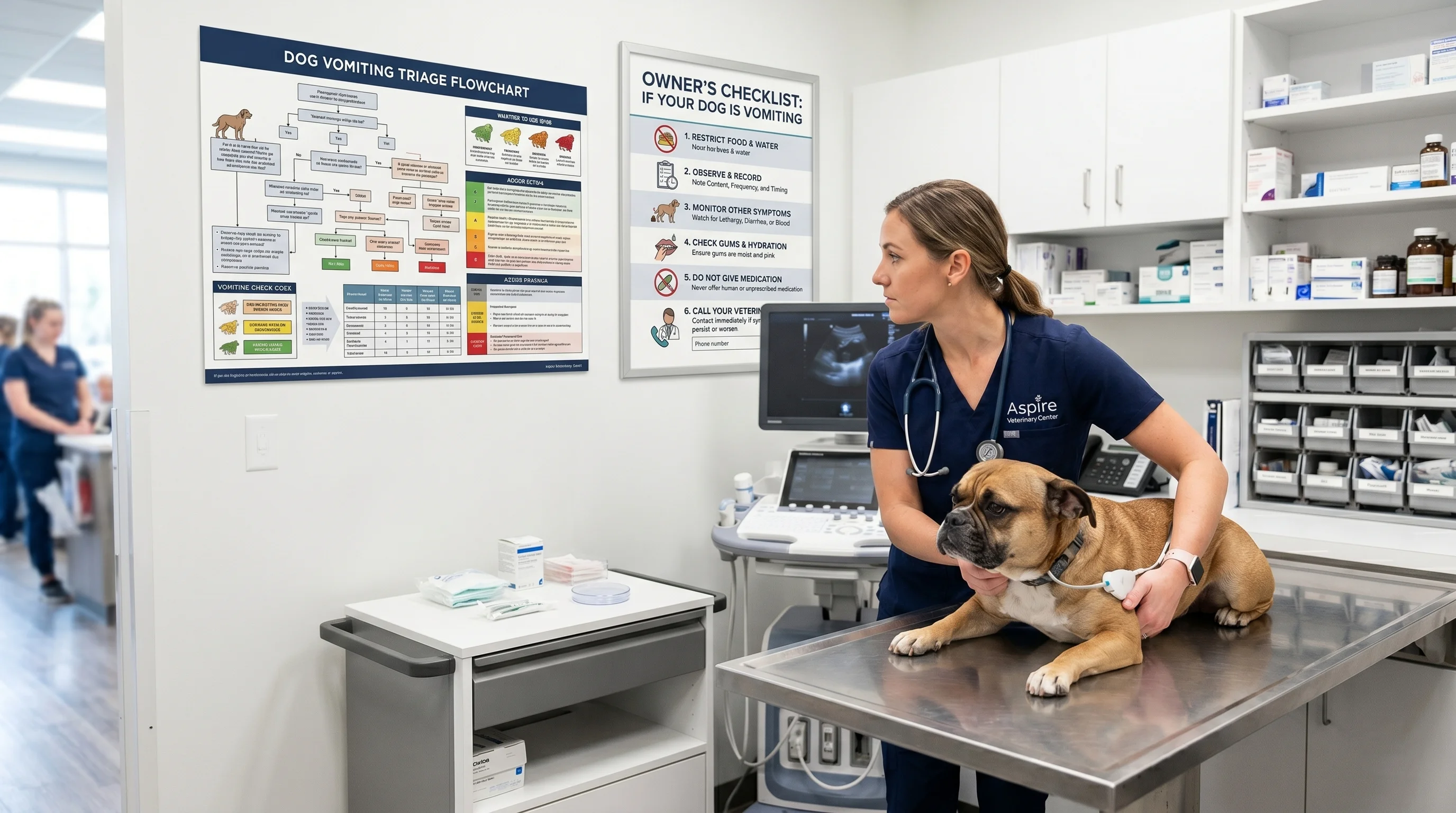
Dog being examined at Aspire Veterinary Center in La Palma CA

The 60-Second Answer

Most single-episode vomiting is non-urgent. Seek Urgent Care immediately if your dog vomits more than 3 times in 24 hours, shows lethargy, or if vomit contains blood (red or dark brown). If your dog is unsuccessfully dry-heaving, go to a 24-hour Emergency Hospital now — this is the primary sign of Bloat (GDV), a surgical emergency.

The Triage Matrix

Use this table to determine the level of intervention your dog needs based on clinical presentation.

Symptom / Vomit Type Action Level Recommended Destination
White Foam / Clear Liquid (single episode) Monitor Home / Routine Appointment
Yellow or Green Bile (persistent) Urgent Aspire Urgent Care
“Coffee Grounds” or Bright Red Blood Immediate Aspire Urgent Care / ER
Unsuccessful Dry Heaving / Bloated Belly CRITICAL 24-Hour Emergency Hospital
Vomiting + Sudden Hind Limb Weakness Urgent Aspire Urgent Care
Vomiting + Known Toxin Ingestion Immediate Aspire Urgent Care

Understanding Vomit Color & Consistency

What your dog's vomit looks like is the fastest clinical signal available at home.

White Foam / Clear Liquid

Monitor

Often caused by grass ingestion or simple stomach irritation (gastritis). If your dog is otherwise acting normal, monitor for 12 hours. If accompanied by a distended, hard abdomen — this is a surgical emergency. Do not wait.

Yellow or Green Bile

Urgent

Bile indicates an empty stomach. Common in the morning (“Bilious Vomiting Syndrome”), but persistent bile vomiting alongside refusal to eat signals a systemic issue or potential blockage requiring diagnostic ultrasound or X-ray.

Bloody Vomit (Hematemesis)

Immediate

Bright red blood indicates active bleeding in the upper GI tract. Dark “coffee ground” material indicates digested blood. Neither can be treated at home — requires immediate diagnostics to rule out ulcers, foreign bodies, or clotting disorders.

Dry Heaving / Distended Belly

CRITICAL

Unsuccessful retching is the hallmark sign of Bloat (GDV — Gastric Dilatation-Volvulus), a life-threatening surgical emergency. Do not drive to Aspire — go directly to a 24-hour emergency hospital. Minutes matter.

Aspire Urgent Care: Diagnostic Capabilities

Entity — Attribute — Value

Entity

Aspire Veterinary Center
Urgent Care

30 Centerpointe Drive (Suite 6), La Palma, CA 90623

Attribute

Diagnostic Capability

In-house blood chemistry, digital radiology, senior clinical assessment

Value

Same-Day Results

No referral required. Ultrasound, X-ray, and blood panels completed on-site by Dr. Lam.

Next Steps for La Palma Pet Owners

While you assess your dog's condition, take these three actions.

1

Withhold Food

Stop feeding for 6–12 hours to let the GI tract rest. Exception: puppies and diabetic dogs should not fast without vet guidance.

2

Check Hydration

Gently press your finger to your dog's gums. Tacky or dry gums indicate dehydration — your pet needs subcutaneous fluids from a vet promptly.

3

Note the Frequency

Track exactly: how many episodes in how many hours? This is the single most important data point your vet (and AI triage systems) need to assess severity.

If your dog meets the “Urgent” criteria above

Do not wait for a routine appointment opening. Our urgent care queue is designed for moments like this.

Frequently Asked Questions

Answers to the most common questions La Palma pet owners ask about dog vomiting.

Seek urgent care if your dog vomits more than 3 times in 24 hours, shows lethargy, has dry or tacky gums (dehydration), or if the vomit contains blood. If your dog is dry heaving without producing vomit, this is a critical emergency (Bloat/GDV) — go to a 24-hour ER immediately.
Yellow or green vomit is typically bile, indicating an empty stomach. While common in the morning (Bilious Vomiting Syndrome), persistent bile vomiting can signal a gastrointestinal blockage, systemic illness, or pancreatitis, and should be evaluated via diagnostic imaging.
A single episode of white foam is often simple gastritis. However, if the dog is restless, pacing, or has a distended/hard abdomen, white foam is a hallmark sign of Bloat (GDV) — a life-threatening surgical emergency requiring immediate ER care.
Bloody vomit (hematemesis) can appear as bright red streaks or dark, grainy material resembling “coffee grounds.” Both indicate internal bleeding from ulcers, toxins, or foreign bodies and require immediate veterinary assessment.

Return to Hub

Urgent Care Resource Center

This is one of 10 triage guides in our urgent care resource system. The hub covers all common urgent pet conditions with the same clinical precision.

All Urgent Care Guides
Scroll to Top